The real estate industry is evolving. Markets shift, interest rates fluctuate, and economic conditions change—but one truth remains constant:
The future of real estate is not determined by the market alone. It is shaped by the knowledge, discipline, and financial awareness of those who participate in it.
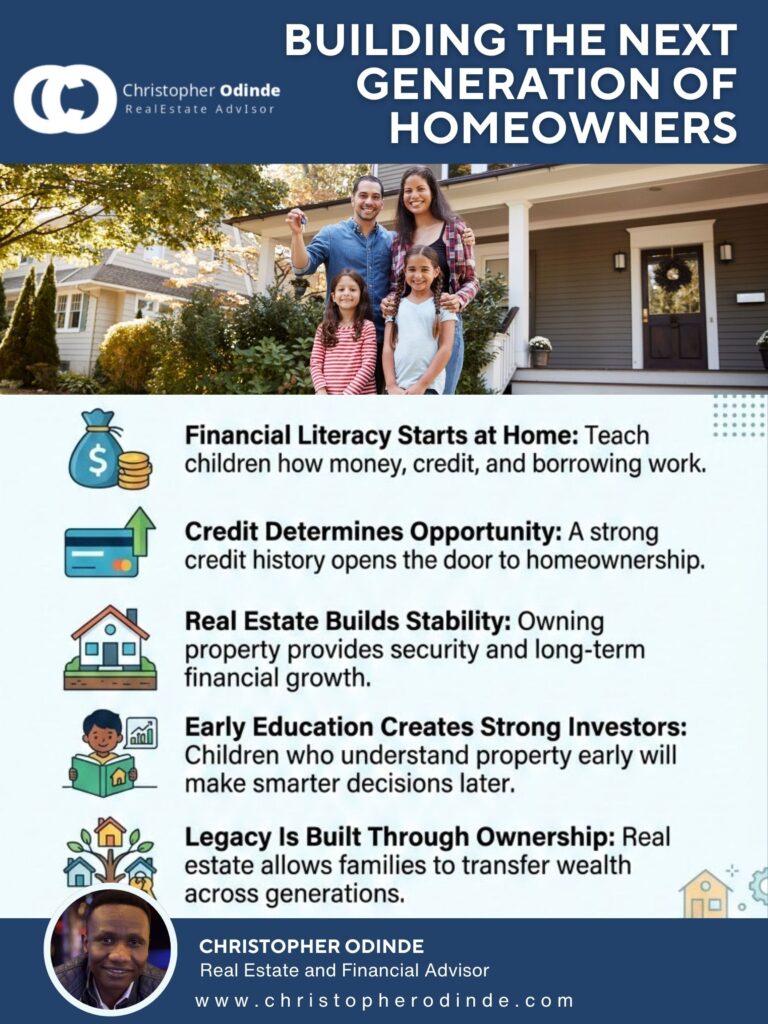
For individuals and families seeking long-term stability and wealth, real estate is more than a transaction—it is a strategy. And that strategy is built on five key pillars.
At the core of every successful real estate journey is a strong understanding of personal finance.
Financial literacy is not just about earning money—it is about:
Managing cash flow
Controlling expenses
Planning for long-term goals
Making informed financial decisions
Without this foundation, even the best real estate opportunities can become financial burdens instead of assets.
When individuals learn to organize their finances effectively, they position themselves to enter the real estate market with confidence and clarity.
In today’s economy, your credit profile is one of your most powerful financial tools.
Creditworthiness reflects:
Your reliability as a borrower
Your financial discipline
Your ability to access opportunities
More importantly, credit is not just something to maintain—it is something to use strategically.
When used wisely, credit becomes a lever that allows you to acquire appreciating assets, including real estate. Many pathways to homeownership are supported by institutions such as the Federal Housing Administration and programs connected to the U.S. Department of Veterans Affairs, making it possible for qualified buyers to enter the market with structured financing options.
Understanding how to build and use credit effectively is a defining factor in long-term success.
Real estate is one of the most powerful wealth-building tools—but only for those who understand how it works.
Key principles include:
Location — the driving force behind property value
Appreciation — how property values grow over time
Leverage — using borrowed capital to increase potential returns
Without this knowledge, buyers may make decisions based on emotion rather than strategy.
With it, they can evaluate opportunities, minimize risk, and maximize long-term value.
The future of real estate does not stop with one purchase—it extends to the next generation.
One of the most overlooked aspects of wealth building is financial education within the family.
Teaching children about:
Money management
Credit
Investing
Homeownership
…creates a cycle of knowledge and opportunity that can last for generations.
Families that prioritize education around real estate and finance are not just building wealth—they are building legacy systems.
True wealth is not just what you build—it is what you preserve and pass on.
Legacy planning involves:
Structuring assets effectively
Protecting wealth from unnecessary loss
Ensuring smooth transfer to future generations
Real estate plays a critical role in this process because it is a tangible, enduring asset that can provide both income and long-term value.
Those who think beyond immediate gains and plan for generational impact position themselves differently. They move from short-term success to lasting influence.
The future of real estate will belong to those who approach it with intention, education, and strategy.
It is not about timing the market perfectly.
It is about preparing yourself to act when opportunities arise.
When you combine:
Financial literacy
Strong credit
Investment knowledge
Family education
And legacy planning
You create more than just ownership—you create a framework for generational wealth.
I believe in building wealth with purpose. Empowering individuals, families, and immigrants to build wealth through real estate ownership and financial mastery.
© 2025 Christopher Odinde