
Webinar Ready to Build Your Real Estate Portfolio? Let’s Talk. We’ve all heard the stories: the “accidental landlord” who turned a spare condo into a goldmine, or the mogul who started with one duplex and now owns half the block. It sounds like the dream, right? Passive income, tax breaks, and a tangible asset that grows while you sleep. But if you’re standing on the sidelines, the gap between “I want to invest” and “I just closed on my third property” can feel like a canyon. Estate Portfolio We’ve all heard the stories: the “accidental landlord” who turned a spare condo into a goldmine, or the mogul who started with one duplex and now owns half the block. It sounds like the dream, right? Passive income, tax breaks, and a tangible asset that grows while you sleep. But if you’re standing on the sidelines, the gap between “I want to invest” and “I just closed on my third property” can feel like a canyon. The truth? Building a portfolio isn’t about having millions in the bank—it’s about having a strategy. If you’re ready to stop dreaming and start scaling, here is how we get the ball rolling. 1. Define Your “Why” (and Your “How”) Before you look at a single listing, you need to know what kind of investor you want to be. Are you chasing cash flow (monthly profit) or appreciation (long-term wealth)? The Buy-and-Hold: Classic rental properties. Reliable, steady, and great for long-term wealth. The BRRRR Method: Buy, Rehab, Rent, Refinance, Repeat. This is the “fast track” for those willing to get their hands dirty. Short-Term Rentals: Airbnbs and vacation spots. Higher management intensity, but often higher yields. 2. The Power of “Leads” Over “Listings” By the time a property hits a major real estate site, the competition is fierce. Building a true portfolio requires finding value where others don’t. This means looking for: Off-market deals. Distressed properties with “good bones.” Emerging neighborhoods just outside the current “hot spots.” 3. Treat It Like a Business, Not a Hobby A portfolio isn’t just a collection of houses; it’s a business entity. To scale successfully, you need your “Board of Directors” in place: A Savvy Lender: Someone who understands investor-specific loans (like DSCR loans). A Rock-Star Property Manager: Because “passive” income shouldn’t mean a 2:00 AM phone call about a leaky toilet. A Trusted Contractor: To keep your margins tight and your finishes sharp. The Reality Check Real estate is a marathon, not a sprint. You might start with a modest $200,000 condo, but through the power of equity and leverage, that one unit can become five in a few short years. Pro Tip: Don’t wait to buy real estate. Buy real estate and wait. Let’s Get Practical If you’ve been waiting for a “sign” to start your investment journey, this is it. But you shouldn’t go it alone. Whether you’re looking for your first rental or your tenth, the right move depends on current market data and your specific financial goals.
Stop Buying a ‘Home’ and Start Acquiring Assets
Beyond the Front Door The Emotional Trap of the “Dream Home” When you look for a home, you’re looking through an emotional lens. You’re thinking about the color of the walls, the size of the backyard for the kids, or how close it is to your favorite coffee shop. While these things are important for your quality of life, they often cloud your judgment of the property’s financial performance. When you buy emotionally, you are more likely to: Overpay because you “fell in love” with the house. Over-improve the property with luxury finishes that won’t yield a return on investment. Ignore market data in favor of personal convenience. Why You Need to Stop Buying a ‘Home’ and Start Acquiring Assets For most people, buying a home is the single largest financial transaction of their lives. It’s a milestone often celebrated with champagne and a set of shiny new keys. But as a Wealth Coach and Financial Advisor, I’m going to tell you something that might surprise you: Your dream home is often your biggest financial liability. If you want to build true, generational wealth, you need to shift your mindset. You need to stop looking for a “home” and start looking for an asset. What Does it Mean to Buy an “Asset”? An asset, by definition, is something that puts money into your pocket. A liability is something that takes money out. When I advise my clients to look for an asset, we focus on three specific financial pillars: 1. The Numbers Over the Neighborhood An asset is chosen based on its Capitalization Rate (Cap Rate) and cash flow potential. If you were to move out tomorrow, would the rent cover the mortgage, taxes, insurance, and maintenance? If the answer is no, you haven’t bought an asset; you’ve bought a high-priced hobby. 2. Forced Equity and Appreciation A “home” owner waits for the market to go up. An investor looks for ways to force the value up. Whether it’s adding a secondary suite, optimizing the layout, or buying in a path of planned urban development, an asset-first approach focuses on growth that you can control. 3. The Tax Shield As a Financial Advisor, I help clients see the hidden “income” in real estate. From depreciation to interest deductions, an asset provides tax advantages that a simple primary residence often cannot match. How to Make the Shift You don’t have to live in a warehouse to be an investor. You can still live in a beautiful house—but you should purchase it with an investor’s exit strategy. Ask yourself: “If the market drops 10% tomorrow, how does this property protect my net worth?” Analyze the ‘Highest and Best Use’: Is this property a single-family home today but a potential multi-family lot tomorrow? Building Your Wealth Strategy Real estate is the most proven vehicle for building wealth, but only if it’s driven by a strategy, not a dream. My mission as your Wealth Coach is to ensure that every door you unlock is a door to financial freedom. Ready to stop “housing” your money and start growing it? Let’s look at your portfolio through a different lens. Visit me at www.christopherodinde.com to book a strategy session.
The Ultimate Guide for home-buyers
The Ultimate Homeownership Guide Many people dream of owning a home, but the process of making that goal a reality may be quite difficult. You can find a property you love that fits your budget and navigate the homebuying process with confidence if you have the proper advice and are prepared. We will walk you through every step of the homebuying process in this guide so you can be ready to make informed choices. We will go over everything you need to know, from examining your financing possibilities to closing on your new house. Here’s to making your homeownership dreams come true. Book Description The Ultimate Guide for Homebuyers: Everything You Need to Know Before You Buy Your Home is a practical, easy-to-understand roadmap designed to help buyers navigate the homeownership journey with clarity and confidence. From preparing your finances and understanding credit, to choosing the right loan, making a strong offer, and successfully closing on a home, this book breaks down the entire process step by step. It addresses common myths, costly mistakes, and overlooked details that often confuse first-time buyers and even experienced homeowners. Whether you are buying your very first home or planning your next property as a strategic investment, this guide equips you with the knowledge, tools, and mindset needed to make smart decisions that lead to long-term stability and wealth through real estate. About the Author Christopher Odinde is a real estate professional, investor, and educator with a passion for helping individuals and families achieve confident and sustainable homeownership. With a background in technology, business, and real estate, Christopher brings a unique, strategic approach to buying and owning property. Having worked closely with first-time buyers, immigrants, and investors, he understands the real challenges people face when entering the housing market. His mission is to simplify real estate, empower buyers with knowledge, and help communities build wealth through informed homeownership decisions. Through his work, Christopher combines practical experience, financial insight, and a heart for service—guiding readers beyond just buying a home, toward building a lasting legacy. Download Your Copy

Buying a home
Getting ready to buy a home Determine Your Budget The first step in buying a home is to establish a clear budget. This involves assessing your financial situation, including your income, savings, and existing debts. Mortgage lenders typically consider your debt-to-income ratio, which compares your monthly debt payments to your gross monthly income. In addition to the purchase price, you should also factor in costs like property taxes, homeowner’s insurance, maintenance, and any homeowners association (HOA) fees. Understanding your financial capacity will help you narrow down your home search and avoid overextending yourself. Get Pre-Approved for a Mortgage Once you have a budget in mind, the next step is to get pre-approved for a mortgage. This is a process where a lender evaluates your financial background and creditworthiness to determine how much they are willing to lend you. A pre-approval letter not only gives you a clearer picture of your price range but also strengthens your position as a buyer. It shows sellers that you are serious and capable of securing financing, which can be a significant advantage in a competitive market. Choose a Location Selecting the right location is just as important as choosing the right home. Consider factors such as the quality of local schools, accessibility to public transportation, proximity to your workplace, and the availability of nearby amenities like grocery stores, parks, and recreational facilities. You might also want to look into safety ratings and the general vibe of the neighborhood. Researching potential developments in the area can also provide insight into future growth that may affect property values. Find a Real Estate Agent Having a knowledgeable real estate agent can make a significant difference in your home-buying experience. An agent can help you navigate the complexities of the real estate market, offering access to listings that match your criteria and helping you stay informed about market trends. They also facilitate communication with sellers and other stakeholders, ensuring that you are well-represented throughout the process. When selecting an agent, look for one with good reviews and a solid track record in your preferred neighborhoods. Start House Hunting With your budget established, pre-approval in hand, and an agent on your side, it’s time to start house hunting. Create a list of must-haves and nice-to-haves to guide your search. Attend open houses to get a feel for different properties, and don’t hesitate to ask your agent for private showings of homes that catch your eye. Take notes during your viewings to help you remember details about each property, as it can be overwhelming to keep track of multiple homes. Make an Offer When you find a home that meets your needs, the next step is to make a formal offer. Your real estate agent will help you formulate an offer that reflects the home’s market value and the current conditions. They will also explain contingencies that can protect you, such as financing and inspection contingencies. Once both parties agree, your offer will enter into a negotiation phase, where you may need to go back and forth until reaching mutually agreeable terms. Home Inspection After your offer is accepted, it’s crucial to conduct a home inspection. This step allows you to identify any potential issues with the property before finalizing your purchase. A qualified home inspector will evaluate the home’s condition, including structural aspects, electrical systems, plumbing, and HVAC systems. Based on the findings, you may negotiate repairs or credits with the seller or, in some cases, decide to withdraw your offer if the issues are extensive. Finalize Financing After the inspection, you’ll finish securing your mortgage. This task involves working closely with your lender to finalize the loan terms, complete any required paperwork, and provide additional documentation as needed. Ensure that you understand the interest rates, terms, and any fees associated with your mortgage. It’s an important step that sets the stage for the closing process. Closing The closing is the final step in the home-buying process, where ownership is officially transferred. During this meeting, you’ll review and sign various legal documents, including the mortgage agreement and title transfer documents. Be prepared to pay closing costs, which may include loan origination fees, appraisal fees, and title insurance. After the paperwork is completed and funds are disbursed, you will receive the keys to your new home! Move In Once the sale is finalized, you can make arrangements to move into your new home. It’s a time filled with excitement as you begin to personalize your space. Planning your move efficiently—whether hiring movers or enlisting friends—can help reduce stress. Take your time settling in and exploring your new neighborhood, making sure to establish utilities and address any immediate needs for your new home. If you have specific questions about any of these steps or need further information, feel free to contact me!
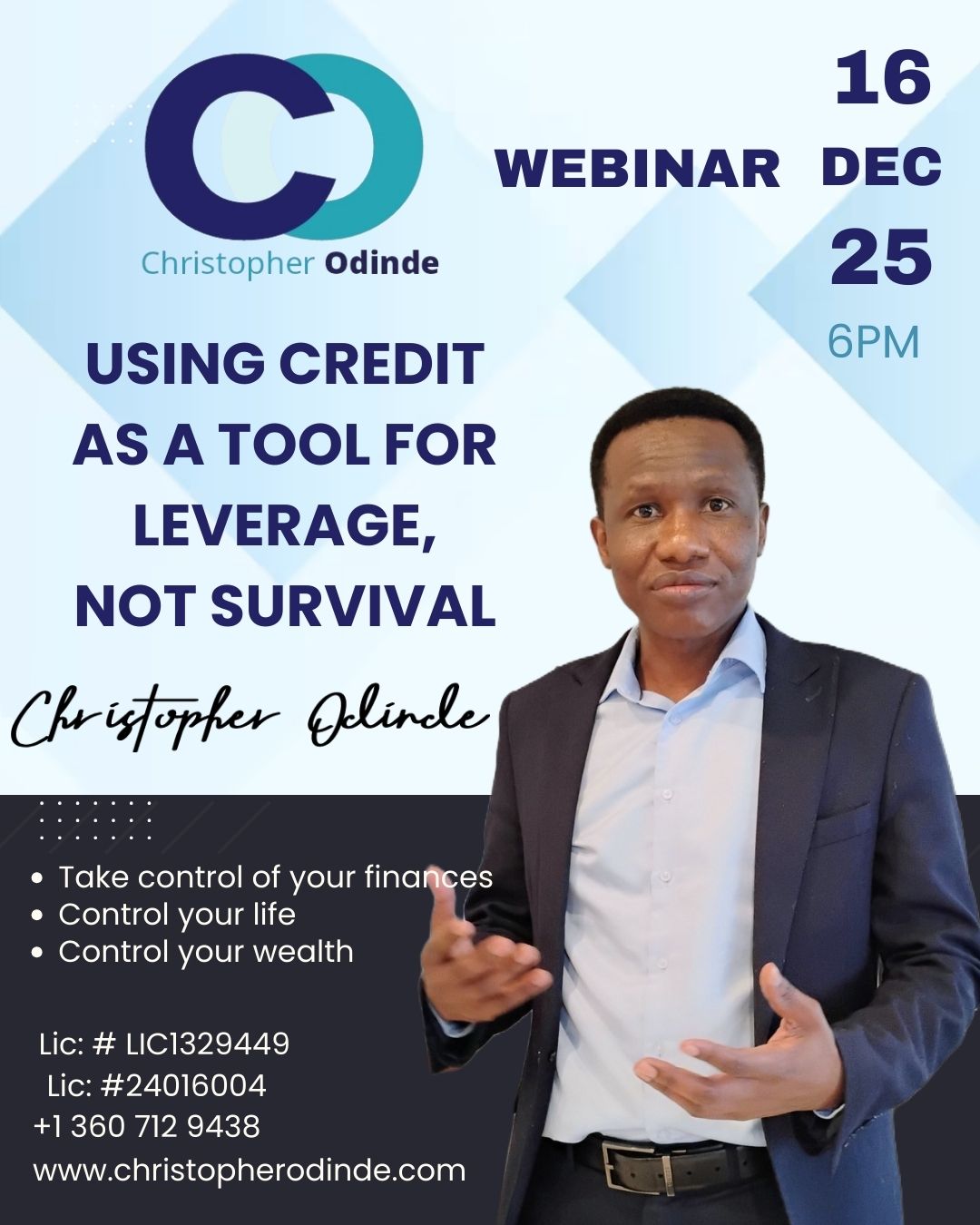
Webinar Dec 16 2025
Webinar Dec 16 2025 Webinar Dec 16, 2025 at 16:40 PST Meeting records Recording Summary Christopher Odinde asserted that credit is the new currency and a double-edged sword in the American economy, which functions as a tool for empowerment but necessitates financial discipline to avoid the compounding interest strategies used by financial giants like JP Morgan, Wells Fargo, and Chase. Mr. Odinde outlined core strategies for taking control of personal finances, including saving and budgeting, differentiating between good and bad debt, strategically building credit by utilizing credit unions and minimizing credit card usage, and leveraging credit for asset acquisition such as home ownership. The discussion, in which Ken Gatimu and Elizabeth Kanee (Betty Hamisha) also participated, concluded with Christopher Odinde offering free consultation services for personal financial planning and sharing their contact information: 360-712-9438 and Christopherodimde.com, upon inquiry from Julius Nzima. Details Notes Length: Standard The Credit Economy and Wealth Creation Christopher Odinde asserted that credit is the new currency, and the American economy operates on it, which can be confusing for those not born in the US. They explained that credit enables the working and middle classes to acquire things they cannot immediately afford, thus compelling them to work and drive the economy. Mr. Odinde emphasized that although credit provides this capability, the principle that “the borrower is a servant to the lender” still applies, making financial discipline crucial. Money as a Tool for Empowerment Christopher Odinde defined money not as a gift, but as a tool for empowerment that influences one’s thinking, speech, and self-expression. They stressed that the only money that can truly save a person is the money they save, emphasizing the importance of savings. Mr. Odinde also noted that when someone spends money, they lose the coverage and empowerment that money offers. Strategies of Financial Giants and Compound Interest Christopher Odinde discussed the financial strategy employed by large institutions, stemming from John D. Rockefeller: “dominate, consolidate and control”. This strategy is visible in companies like Google, Amazon, and financial institutions such as JP Morgan, Wells Fargo, and Chase. Mr. Odinde highlighted that when credit is created, debt is born, leading to interest and compounding interest, which they called the “eighth wonder of the world”. This system can cause debt to grow quickly and out of control for borrowers, while being used by banks and the wealthy to make substantial money. Taking Control of Personal Finances Christopher Odinde clarified that the purpose of the discussion is for individuals to take back control of their finances and resources. They outlined three essential steps: identifying the problem with cash flow, reviewing the situation to understand how they reached their current financial state, and creating a plan. Mr. Odinde, a certified financial advisor, noted that professional help is available, but these basic steps can be done independently. Financial Discipline and Leverage Christopher Odinde emphasized the necessity of financial discipline because credit is a “double-edged sword” that can empower but also cause significant harm. They clarified that they are not advising everyone to take on debt, but rather to use it wisely and strategically, especially at certain phases of life, such as when buying a house. Mr. Odinde explained that taking control involves using the principle of leverage and keeping track of finances and income. Strategies for Managing Credit and Debt Christopher Odinde outlined core strategies, starting with saving and budgeting everything, however tedious it may be, to avoid financial surprises. They cautioned against using credit cards as income, reiterating that credit is a tool, not extra money. Mr. Odinde also differentiated between good debt, which generates assets that increase in value or income (e.g., mortgages, investments in shares), and bad debt, which is used for consumption (e.g., groceries, personal loans). Building Credit Score and Managing Credit Cards Christopher Odinde gave specific advice for building credit, including using credit cards to build credit rather than out of necessity, and paying the balance in full. They recommended using only 30% to 50% of the credit limit and avoiding the closure of old credit card accounts to maintain a longer credit history, which is important for lenders. Mr. Odinde also suggested using credit unions, which offer unconventional ways to build credit without incurring traditional debt, such as through credit building accounts. Handling Existing Bad Debt and Impulse Purchases Christopher Odinde advised those already burdened with bad debt to contact their credit card companies to discuss potential plans or alternatives, such as stopping compounding interest or paying back only the principal. They stressed the need for a fundamental change in mindset regarding debt, viewing it as a deliberate choice, not an accidental state. Mr. Odinde also warned participants to be cautious about accepting credit cards impulsively, especially at shops, and to take a cool-off period of at least 24 hours before making purchases that are not assets. Leveraging Credit for Immediate Needs and Asset Acquisition Christopher Odinde provided examples of how to strategically leverage credit, such as using the 30-day grace period for immediate needs like exam fees or medical expenses before repayment is due. They also suggested leveraging credit for immediate investments with better returns, asset acquisition for business or personal growth, and taking advantage of offers and promotions, emphasizing that a proper repayment plan must always be in place. Ultimately, Mr. Odinde highlighted buying property with a mortgage as the biggest example of leveraging credit for long-term wealth, equity building, and tax advantages. Advantages of Home Ownership and Starting Small Christopher Odinde emphasized the benefits of owning a home over renting, noting that money spent on rent is “flushed down the toilet” while ownership builds equity, offsets taxes, and provides control and appreciation. They encouraged starting with a smaller, more affordable house, such as one worth $300,000, for people currently paying around $1,500 in rent, suggesting the rent money could be leveraged for a mortgage payment of about $2,000. This strategy allows individuals to start building ownership and wealth, even if

Landlords Make Wealth in Their Sleep
Here’s Why Most people trade time for money. They wake up, go to work, and earn a paycheck that stops the moment they stop working. Landlords, however, build systems that generate income whether they are awake or asleep. This is not luck, and it is not magic—it is the result of owning assets that produce cash flow, grow in value, and benefit from time itself. At the heart of a landlord’s wealth is recurring rental income. Each month, tenants pay rent, and that rent covers expenses such as the mortgage, taxes, insurance, and maintenance. Over time, what remains becomes predictable cash flow. Unlike wages that depend on constant labor, rental income continues as long as the property is well managed and in demand. This steady flow of income creates financial stability and frees landlords from living paycheck to paycheck. Another powerful advantage landlords enjoy is appreciation. Real estate tends to increase in value over the long term due to population growth, limited land supply, inflation, and economic development. While owners go about their daily lives, their properties quietly grow in value. This means a landlord can become significantly wealthier on paper without actively doing anything, simply by holding the asset over time. Landlords also understand leverage—using other people’s money to build wealth. By using credit responsibly, they control valuable properties with relatively small down payments. Tenants then help pay down the mortgage, effectively buying the property for the landlord over time. When used wisely, credit stops being a burden and becomes a tool for expansion and wealth creation. The tax system further rewards property owners. Landlords can deduct expenses related to maintaining and operating their properties, and they benefit from depreciation, a non-cash expense that reduces taxable income. While employees often pay taxes first and live on what remains, landlords structure their finances so they legally reduce taxes and reinvest more of their income into growing their portfolio. Inflation, which erodes the purchasing power of cash, works in favor of landlords. As the cost of living rises, rents typically increase, but fixed-rate mortgage payments remain the same. Over time, landlords repay yesterday’s debt with today’s inflated dollars, while their income keeps pace with rising prices. This natural hedge against inflation is one of real estate’s most underestimated strengths. Every rent payment also builds equity. As the mortgage balance decreases and the property value rises, landlords accumulate wealth they can access through refinancing or borrowing. This equity can be used to acquire additional properties, allowing wealth to compound. One property can eventually lead to many, all funded by systems rather than constant labor. Perhaps most importantly, landlords focus on systems instead of stress. With professional property managers, automated rent collection, and reliable maintenance teams, real estate can become largely passive. Once the right structures are in place, income continues with minimal day-to-day involvement, making true “sleep-time wealth” possible. In the long run, rental real estate creates generational wealth. Properties do not retire, call in sick, or stop producing income. They can be passed down to children, providing long-term financial security and opportunity. This is how families shift from survival to stability, and from stability to legacy. Landlords do not get rich overnight. They get rich deliberately, patiently, and strategically. By owning assets instead of selling time, they allow money, time, and systems to work together. That is why landlords make wealth in their sleep—and why real estate remains one of the most powerful wealth-building tools ever created.